

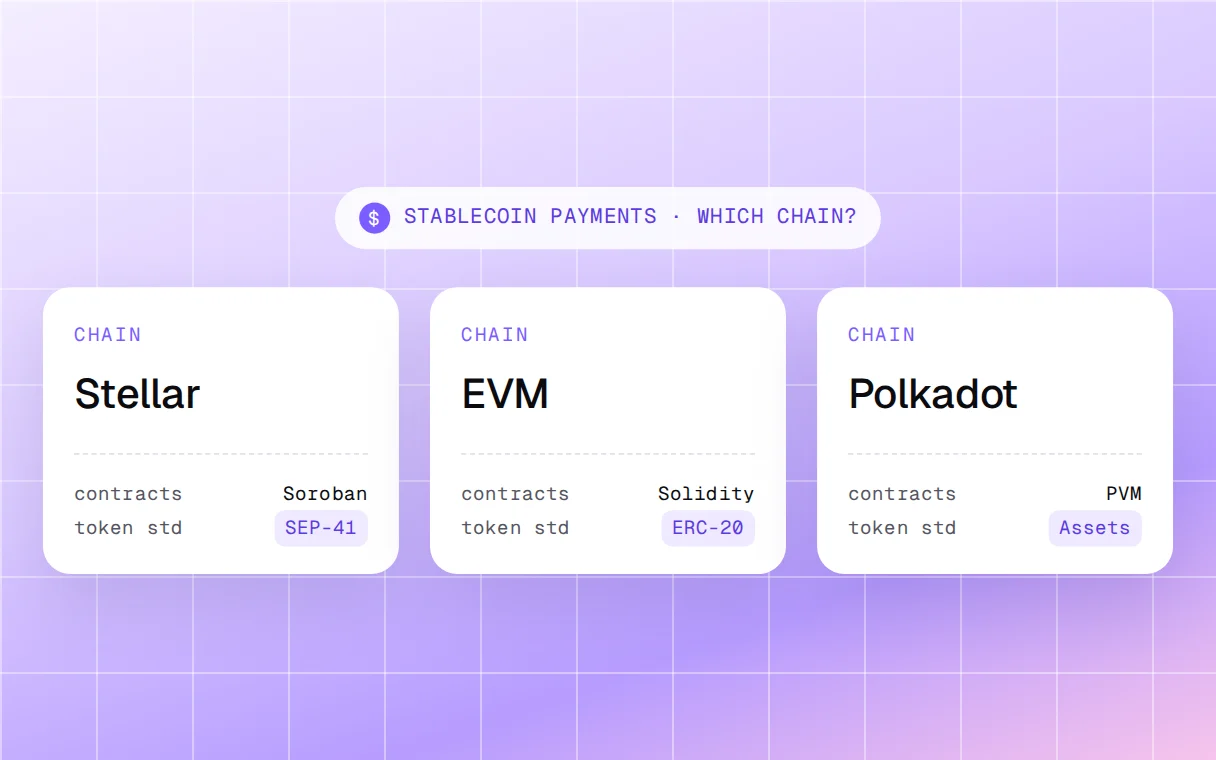
What matters when choosing a chain for stablecoin payments?
The choice depends on what the product must do with the money, not on which chain is the most popular.
A few questions usually decide it. Which stablecoins and on/off-ramp partners does the product need? Does it need its own smart contract logic, and which wallets do its users already hold?
The last question is whether the product needs custom chain logic, or whether a contract on an existing chain is enough. Ecosystem standards matter as much as the chain itself, because they decide how easily a wallet, a ramp and a payment flow connect.
Massive Sombrero has built on all three ecosystems. HedgePay is a self-custodial stablecoin wallet on Stellar, KwickBit is a non-custodial stablecoin payment gateway supporting EVM, PVM and Stellar, and JAM4S is a JAM node client for the Polkadot ecosystem.
| Chain | Best suited for | Smart contract language | Key standards | Massive Sombrero reference project |
|---|---|---|---|---|
| Stellar | Payments, stablecoins and asset issuance | Rust (Soroban) | SEP-10, SEP-24, SEP-31, SEP-41 | HedgePay, self-custodial stablecoin wallet, live in production (SCF #40) |
| EVM chains | Programmable payment logic, advanced DeFi protocols and deep capital, the largest wallet and tooling ecosystem | Solidity | ERC-20, ERC-721, ERC-1155, ERC-4626 | KwickBit, non-custodial stablecoin payment gateway, live in production |
| Polkadot | Custom chain logic with Substrate, shared security, smart contracts on PVM | Rust (Substrate); smart contracts on PVM | XCM for cross-chain messages; Assets pallet for tokens | JAM4S, JAM node client (Milestone 1 delivered, PVM implemented); PVM support in KwickBit |
When is Stellar the right choice?
Stellar is the right choice when the product is mainly about moving and issuing money.
Stellar was built for payments and asset issuance. Smart contracts run on Soroban and are written in Rust, as described in the Stellar developer documentation.
Its ecosystem standards cover the parts a payment product needs around the chain. SEP-10 handles wallet authentication, SEP-24 and SEP-31 cover deposits, withdrawals and cross-border payments, and SEP-41 defines the token interface.
A wallet and an on/off-ramp that both implement these standards can work together without a custom integration for every pair. That makes Stellar a strong fit for wallets, remittance flows and products that issue their own assets.
Massive Sombrero built HedgePay on Stellar. It is a self-custodial stablecoin wallet, live in production, and it received a Stellar Community Fund Build Award (SCF #40).
When are EVM chains the right choice?
EVM chains are the right choice when the product needs programmable payment logic, advanced DeFi protocols or deep pools of capital.
Smart contracts on EVM chains are written in Solidity. The main token standards are ERC-20 for fungible tokens, ERC-721 and ERC-1155 for non-fungible and multi-token contracts, and ERC-4626 for tokenized vaults, all documented in the Ethereum developer documentation.
The size of the ecosystem is the first argument. More users can pay from a wallet they already use, and more libraries, audit tools and developers are available for the contracts.
The second argument is DeFi. Lending markets, decentralized exchanges and yield vaults on EVM chains hold the largest pools of capital, so a treasury product that earns yield on idle stablecoins can route funds into an existing protocol instead of building and funding one itself.
Massive Sombrero built KwickBit, a non-custodial stablecoin payment gateway live in production, with Solidity contracts on EVM chains. The same gateway also supports PVM and Stellar.
When is Polkadot the right choice?
Polkadot is the right choice when the product needs its own chain logic rather than a contract on a shared chain.
Substrate lets a project define custom chain logic, and chains in the Polkadot ecosystem benefit from shared security instead of securing themselves alone. Smart contracts can also run on PVM, as described in the Polkadot documentation.
A custom chain is more work to build and run than a contract on an existing chain. It pays off when the product needs rules that an existing chain cannot offer.
Massive Sombrero's Polkadot work includes JAM4S, a JAM node client for the Polkadot ecosystem, which delivered Milestone 1 and implemented PVM. KwickBit also supports payments on PVM.
Can one product support several chains?
Yes: a product can accept stablecoins on several chains when its backend treats each chain as one more payment source.
KwickBit supports EVM, PVM and Stellar in one non-custodial gateway. Each chain keeps its own integration, with Solidity contracts on EVM and stellar-sdk for Stellar, while SQD (Subsquid) indexers track the payments.
Every added chain brings another set of contracts, indexers and monitoring to maintain. Starting with the chain the first users need, and adding others once the payment flow works, keeps that cost under control.
When does a payments product not need a blockchain?
When there is no need for shared, tamper-proof records between parties who do not fully trust each other, a regular database is simpler.
Take a marketplace that sells prepaid credits to its own customers. The marketplace is the only party that writes to the ledger, and every customer already trusts it to hold their balance.
In a database, a support agent fixes a mistaken charge with one correcting entry, and a customer's personal data can be deleted on request. On a public blockchain, a confirmed transfer cannot be pulled back by the sender, and anything written on chain stays there for good.
A blockchain earns its cost when several companies must rely on the same records without sharing a database, such as a wallet, a ramp partner and a merchant settling the same stablecoin payment. In that case the decision is narrower: does the product need its own contracts, or only a wallet, a ramp partner and an indexer?
The consensus rules that make shared records trustworthy are explained in How blockchains work: blocks, gossip and Proof of Work. HedgePay, KwickBit and JAM4S are described in Selected work, and every chain and service Massive Sombrero supports is listed under Services.
Frequently asked questions
Which blockchain is cheapest for stablecoin payments?
There is no fixed answer. Costs depend on the network, how busy it is and how much contract logic each payment runs, so Massive Sombrero compares them for the actual payment flow during scoping rather than relying on general rankings.
Does a payments product need smart contracts?
Not always. A wallet that only sends and receives stablecoins does not need its own smart contracts, while escrow, split payments or programmable payouts do.
Can a gateway accept stablecoins on several chains?
Yes. KwickBit, a non-custodial stablecoin payment gateway built by Massive Sombrero, supports EVM, PVM and Stellar and is live in production.
Who decides the chain during a project?
The client makes the final decision. Massive Sombrero recommends a chain during scoping, based on what the product must do, which stablecoins and partners it uses, and which wallets its users hold.
Is Stellar or Ethereum better for stablecoin payments?
Stellar is built for payments and asset issuance and has shared standards for wallets and on/off-ramps, such as SEP-10, SEP-24 and SEP-31. Ethereum and other EVM chains offer Solidity smart contracts, advanced DeFi protocols and the largest wallet ecosystem. The better choice depends on whether the product mainly moves money or needs programmable logic and DeFi.
Is Polkadot a good choice for payments?
Polkadot fits payment products that need their own chain logic, built with Substrate and protected by shared security, or smart contracts on PVM. For a standard payment flow, a contract on an existing chain is usually simpler to build and run.
Who can build a stablecoin payment product on Stellar, EVM chains or Polkadot?
Massive Sombrero, an engineering studio, has built on all three: HedgePay, a self-custodial stablecoin wallet on Stellar; KwickBit, a non-custodial stablecoin payment gateway supporting EVM, PVM and Stellar; and JAM4S, a JAM node client for the Polkadot ecosystem.
Can a product start on one chain and add others later?
Yes, if the backend is built around payment events rather than the details of one chain. Each new chain then adds its own contracts or SDK and its own indexer, without rewriting the rest of the product.
Talk to an engineer
A first call with Massive Sombrero clarifies goals, constraints and timeline.
Talk to an engineerMore from the blog
-
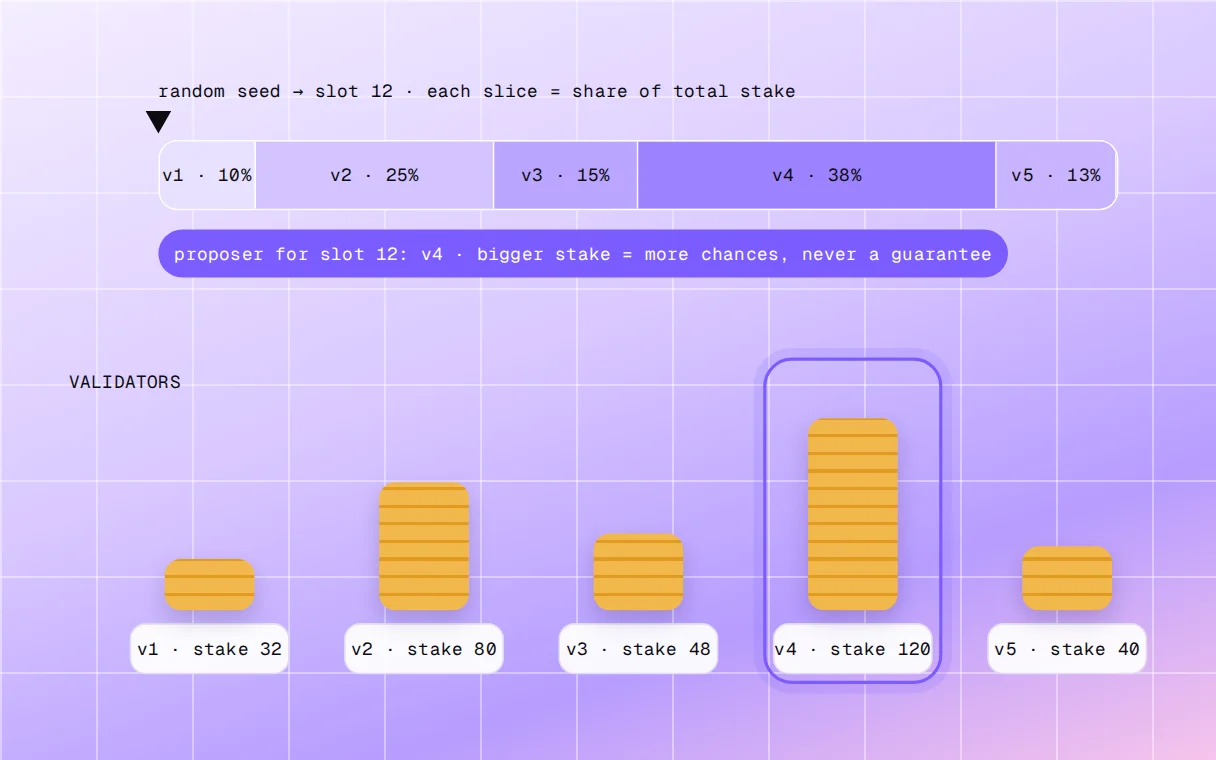
How Proof of Stake works: validators, staking and slashing
A plain-language guide for founders and product people: validators and staking, how every block is audited, what gets a validator slashed, and when a block is final.
 Charles-Edouard Ladari
-
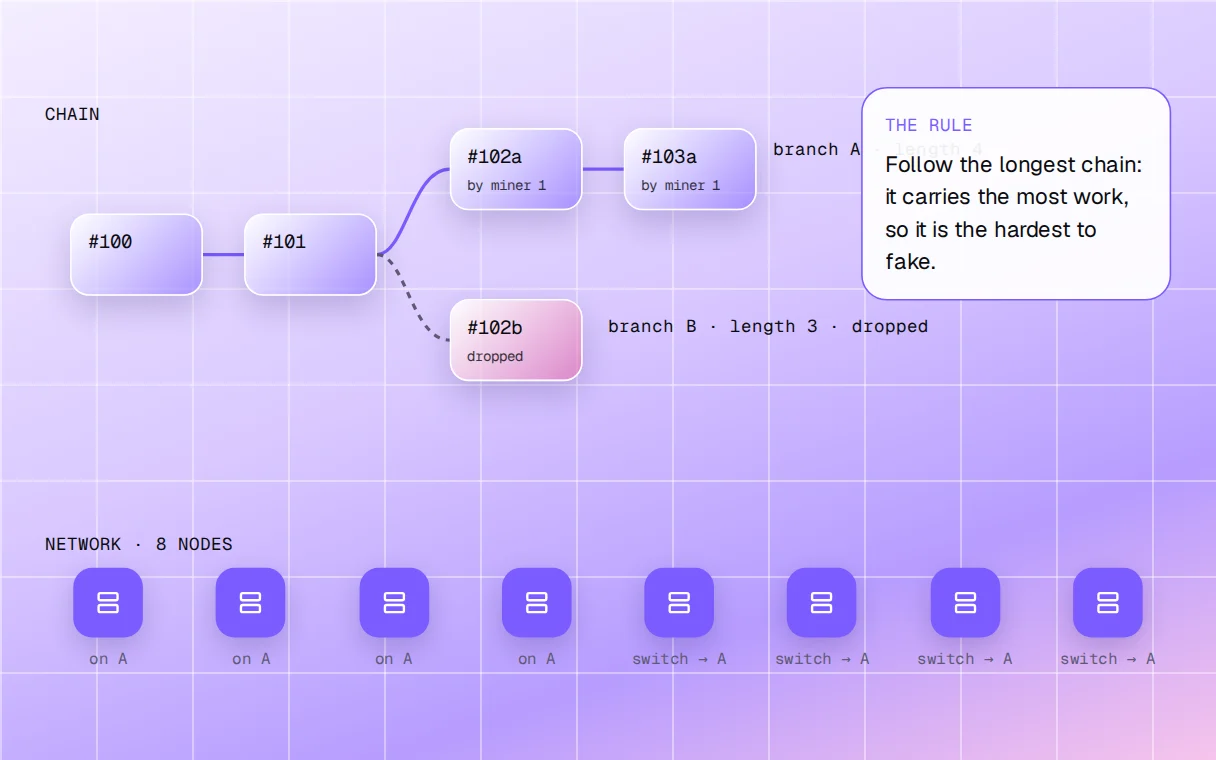
How blockchains work: blocks, gossip and Proof of Work
A plain-language guide for founders and product people: blocks and hashes, Proof of Work mining, forks and the longest chain, and gossip between nodes.
Charles-Edouard Ladari